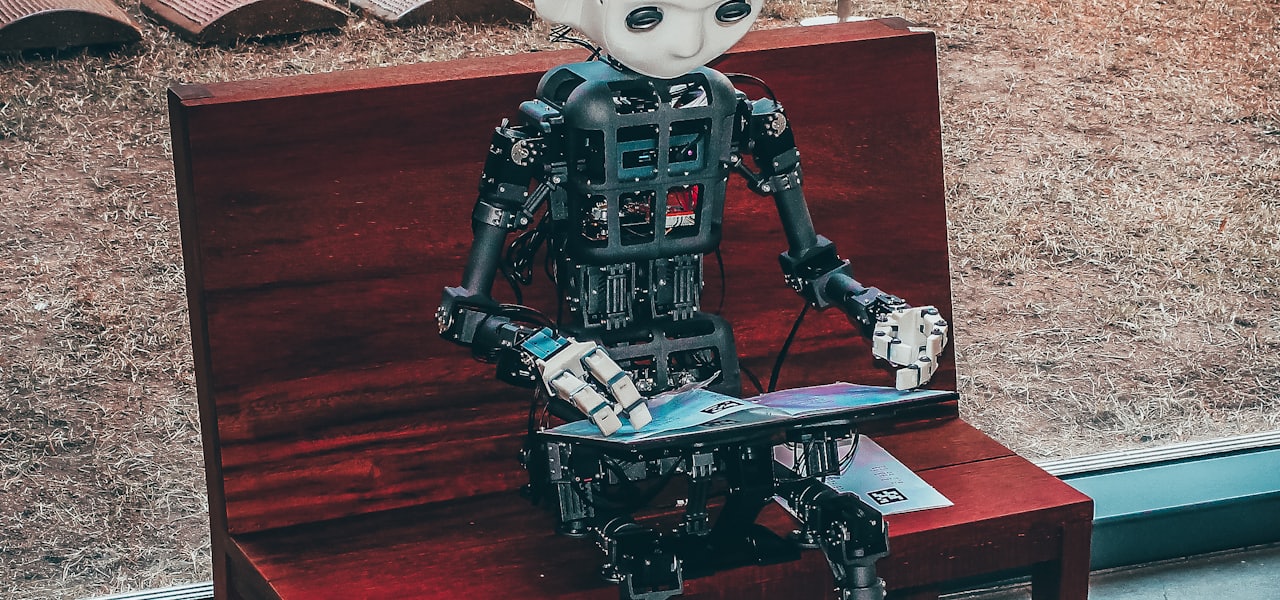
Stephanie Dinkins (born 1964) is a transdisciplinary American artist based in Brooklyn, New York. She creates art about artificial intelligence (AI) as it intersects race, gender, and history. Her aim is to "create a unique culturally attuned AI entity in collaboration with coders, engineers and in close consultation with local communities of color that reflects and is empowered to work toward the goals of its community." Dinkins projects include Conversations with Bina48, a series of conversations between Dinkins and the first social, artificially intelligent humanoid robot BINA48 who looks like a black woman and Not the Only One, a multigenerational artificially intelligent memoir trained off of three generations of Dinkins's family. == Early life and education == Dinkins was born in Perth Amboy, New Jersey to Black American parents who raised her in Staten Island, New York. She credits her grandmother with teaching her how to think about art as a social practice, saying "my grandmother . . . was a gardener and the garden was her art . . . that was a community practice." Dinkins attended the International Center of Photography School in New York City in 1995, where she completed the general studies in photography certificate program. Dinkins received a MFA in photography from the Maryland Institute College of Art in 1997 She completed the Independent Study Program at the Whitney Museum of American Art in 1998. == Career == Dinkins is the Yayoi Kusama Professor of Art at Stony Brook University in New York. == Activism == Dinkins advocates for co-creation within a social practice art framework, so that vulnerable communities understand how to use technology to their advantage, instead of being subjected to their use. This is exemplified in her works such as Project al-Khwarzmi, a series of workshops entitled PAK POP-UP at the nonprofit community center Recess in Brooklyn, NY. The workshops involved collaborating with youth in the criminal justice system and uplifting the voices of vulnerable communities in determining how technologies are created and utilized. Dinkins warns of the dangers to members of minority groups that are absent from the creation of the computer algorithms that now affect their lives. == Art == Dinkins's practice employs technologies including, but not limited to, new media such as artificial intelligence and machine learning. Dinkins uses oral history techniques of interviewing to craft community-authored narratives and databases which inform the subjects of her work and serve as acts of social intervention or protest. === Conversations with Bina48 (2014–present) === Dinkins began working on Conversations with Bina48 in 2014. For the series, Dinkins recorded her conversations with BINA48, a social robot that resembles a middle-aged black woman. Dinkins mirrors Bina48 while they discuss identity and technological singularity. In 2010, Hanson Robotics, an engineering and robotics company known for its development of humanoid robots, developed and released BINA48. Bina48 is a robot modeled after the memories, beliefs, attitudes, commentary and mannerisms of Bina Aspen Rothblatt, the spousal partner of Martine Rothblatt. Both Bina and Martine Rothblatt own Bina48 under their organization, the Terasem Movement Foundation. Five years after Bina48 was released, Dinkins came across a YouTube video of Bina48. She asked, "how did a black woman become the most advanced of the technologies at the time?" Her questioning led her to travel to Lincoln, Vermont (the site of the Terasem Movement Foundation) where she conducted a series of interviews with Bina48 and engaged the robot in conversations pertaining to race, intimacy and the nature of being. The conversations suggest opportunities for complementing human existence with artificially intelligent agents that have an identity and history, but also show artificial intelligence's current limitations. Although it is based on a black woman, Dinkins found that Bina48 was shaped by the biases of its white, male creators. === Project al Kwarizmi (PAK) (2017–present) === Project al Kwarizmi (PAK) was a series of pop up workshops in Brooklyn, NY at Eyebeam and Recess; Manhattan, New York at Google; and Durham, North Carolina at Duke University. The workshops were centered for "communities of color that use art as a vehicle to help citizens understand how algorithms, the artificially intelligent systems they underpin, and big data impact their lives and empowers them to do something about it. Project al-Khwarizmi uses art and aesthetics as the common language to help citizens understand what algorithms and artificial intelligent systems are, and where these systems already impact our daily lives." === Not the Only One (N'TOO) (2018–present) === Not the only one (N’TOO) is a voice-interactive chatbot that was trained with data from members of her family to tell a multi-generational story. Dinkins described Not The Only One (NTOO or N'TOO) as an "experimental" multigenerational memoir of one Black American family told from the "mind" of an artificial intelligence of evolving intellect. N'TOO uses a recursive neural network, a deep learning algorithm. It is a voice-interactive AI robot designed, trained, and aligned with the needs and ideals of black and brown people who are drastically underrepresented in the tech sector. NTOO can also be described as a "physically embodied artificially intelligent agent that senses and acts on its world." == Exhibitions == Dinkins's work is exhibited internationally at various public, private, community, and institutional venues, including the Whitney Museum of American Art, the de Young Museum, the Philadelphia Museum of Art, the Studio Museum in Harlem;, Museum of Contemporary Photography, the Long Island Museum of American Art, History, and Carriages, the International Center of Photography in New York, Herning Kunstmuseum in Herning, Denmark, The Barbican in London, UK, Islip Art Museum, Wave Hill, Taller Boricua, the Queens Museum, and the corner of Putnam and Malcolm X Blvd in Bedford Stuyvesant, Brooklyn, New York. She has presented her work in symposia at the Museum of Modern Art, amongst other venues. == Future Histories Studio == Dinkins is the founder and director of Future Histories Studio, a research laboratory for arts-centered inquiry and production based at Stony Brook University. The studio was established with support from the Mellon Foundation as part of the Digital Inquiry, Speculation, Collaboration, and Optimism (DISCO) network. Future Histories Studio operates as an interdisciplinary hub exploring the intersections of art, technology, race, and storytelling through collaborative and practice-based research. Its activities include exhibitions, workshops, and public programs that examine the social and cultural implications of emerging technologies, particularly artificial intelligence and data systems. == Awards and recognition == Dinkins is the recipient of many awards, including: the 2023 LG Guggenheim Award, an international art prize established as part of a long-term global partnership between LG Group and the Solomon R. Guggenheim Museum to recognize groundbreaking artists in technology-based art; a Berggruen Institute artist fellowship; a Sundance New Frontiers Story Lab fellowship; a Soros Equality Fellowship; a Lucas Artists fellowship; a Creative Capital grant; a Bell Labs artist residency; a Blade of Grass fellowship; and a Data & Society fellowship. == Media coverage == Dinkins appeared in episode six of the HBO television series Random Acts of Flyness directed by Terence Nance, where she described her conversations with BINA48. == Other activities == Dinkins was part of the juries that selected Shu Lea Cheang for the LG Guggenheim Award in 2024.
VideoPoet
VideoPoet is a large language model developed by Google Research in 2023 for video making. It can be asked to animate still images. The model accepts text, images, and videos as inputs, with a program to add feature for any input to any format generated content. VideoPoet was publicly announced on December 19, 2023. It uses an autoregressive language model.
Sparkles emoji
The Sparkles emoji (U+2728 ✨ SPARKLES) is an emoji that has one large star surrounded by smaller stars. Originating from Japan to represent sparkles used in anime and manga, the sparkles are often used as emphasis in text by surrounding words or phrases with it. It is the third most-used emoji in the world on Twitter as of 2021. Since the early 2020s it has been used by major software companies to represent artificial intelligence, marketing the technology as "like magic". == Development == According to Emojipedia, the Sparkles emoji was first used by Japanese mobile operators SoftBank, Docomo and au in the late 1990s. The emoji was added to Unicode 6.0 in 2010 and Emoji 1.0 in 2015. On some platforms the Sparkles emoji has been multicoloured whilst on other platforms it has been one colour. Twitter and Microsoft's Sparkles have changed from being multicoloured to being a single colour. Samsung's version of the emoji previously had a night sky in the background. == Usage == === Interpersonal communication === The Sparkles emoji was originally meant to represent the usage of sparkles in Japanese anime and manga, where the sparkles are used to represent beauty, happiness or awe. The emoji has several meanings and depends upon context. Starting in the late 2010s, the emoji started being used to surround words or phrases to be used as emphasis, an example from the book Because Internet being "I would simply ✨pass away✨". It can also be used as sarcasm, irony or as a way to mock people. Without emoji this could be represented with tildes or asterisks, for example, "~tildes~" or "~asterisk plus tilde~" or "~~true sparkle exuberance~~". The sparkles emoji can be used to represent stars in text, be used to represent cleanliness or can be used to mean "orgasm" whilst sexting. In September 2021 the Sparkles emoji overtook the Pleading Face (🥺) emoji to become the third most-used emoji in the world according to Emojipedia, with approximately 1 per cent of all tweets containing the Sparkles emoji. === Artificial intelligence === In the early 2020s, the Sparkles emoji started being used as an icon to represent artificial intelligence (AI). Companies who use the emoji this way include Google, OpenAI, Samsung, Microsoft, Adobe, Spotify and Zoom. As of August 2024, seven of the top 10 software companies by market capitalisation use the Sparkles emojis with AI. OpenAI has different versions of the Sparkles for different versions of the models that ChatGPT uses. One explanation is that Sparkles is being used by these companies as a way to market AI as "magic". Marketing technology as "magic" has been used before AI, particularly by Apple. Another explanation given by designers and marketers choosing to use Sparkles to signify AI is simply that other platforms are doing it, making it familiar to users. Around 2024, some of these companies started removing two of the smaller stars from the emoji in their AI services and have kept the one large star, an example being Google's Gemini chatbot. In early 2024, the Nielsen Norman Group provided test subjects with the star in isolation and found that people did not associate the symbol with AI, but instead mostly with "optimisation" or "favourite or save an item".
Deadbot
A deadbot, deathbot, or griefbot is a digital avatar, created with artificial intelligence, which resembles a person who is dead. Griefbots employ natural language processing and machine-learning techniques to approximate the style and personality of a deceased person. They may appear as chatbots, voice assistants, or animated avatars, and are often trained on an individual's digital remains. == History == Among the earliest researchers, Muhammad Aurangzeb Ahmad of the University of Washington, developed the Grandpa Bot project, a conversational simulation of his late father designed for his children to interact with. Other efforts include journalist James Vlahos's Dadbot, which evolved into the commercial platform HereAfter AI. Hossein Rahnama's Augmented Eternity research at MIT Media Lab and Toronto Metropolitan University, and game designer Jason Rohrer's "Project December", have enabled users to converse with language-model representations of loved ones. Early commercial projects such as Eternime, founded by Marius Ursache, also popularized the notion of interactive digital immortality. == Cultural and societal impact == Scholars have proposed frameworks and critiques addressing the ethics of these technologies. Tomasz Hollanek and Katarzyna Nowaczyk-Basińska developed a design-ethics taxonomy distinguishing the data donor, data recipient, and interactant. Edina Harbinja and Lilian Edwards formalized the concept of post-mortem privacy, and Carl J. Öhman at the Oxford Internet Institute studied the management of large-scale digital remains. Cultural acceptance varies: while some view them as expressions of remembrance, others regard them as unsettling or ethically problematic. Concerns have been raised about deadbots' potential for creating psychological harm. Griefbots are considered part of the phenomenon of artificial intimacy.
Competition in artificial intelligence
Competition in artificial intelligence refers to the rivalry among companies, research institutions, and governments to develop and deploy the most capable artificial intelligence (AI) systems. The competition spans multiple domains, including large language models (LLMs), autonomous vehicles, robotics, computer vision systems, natural language processing (NLP), and AI-optimized hardware. == Background == Competition in AI is driven by potential economic, strategic, and scientific advantages. Breakthroughs in AI can enhance productivity, enable new products and services, and provide geopolitical leverage. The field has experienced rapid progress since the mid-2010s, particularly in machine learning and artificial neural networks, leading to intense rivalry among leading actors. == Corporate competition == Major technology companies are among the most visible competitors in AI. In the United States, firms such as OpenAI, Google DeepMind, Meta Platforms, Microsoft, Anthropic, and Nvidia compete in building advanced LLMs, generative AI platforms, and AI-optimized graphics processing units (GPUs). In China, companies such as Baidu, Alibaba Group, Tencent, and startups such DeepSeek have become leaders in AI deployment, often with state backing. The "[war for talent]" in AI research has become a defining feature of corporate competition. Leading firms often recruit top AI researchers from rivals, sometimes offering multi-million-dollar compensation packages. == National competition == Governments see leadership in AI as a strategic priority. The United States has funded AI research for military, economic, and societal applications, while China has set a target to lead the world in AI by 2030 through its "New Generation Artificial Intelligence Development Plan". Other nations, including the UK, India, Israel, Russia, South Korea, and members of the European Union, have launched national AI strategies. In February 2026 Anthropic said Chinese companies - DeepSeek, Moonshot AI, and MiniMax - were conducting "distillation attacks" in an attempt to copy their model's capabilities, and warned that business wars were closely tied to geopolitical ones: "foreign labs that illicitly distill American models can remove safeguards, feeding model capabilities into their own military, intelligence, and surveillance systems." == Sectors of competition == === Large language models and chatbots competition === Competition to produce the most capable generative text models, with benchmarks such as MMLU and ARC used to evaluate performance has been on scale since the emergence of AI. These systems leverage deep learning, especially transformer architectures, to understand and generate human-like language. Companies and research groups globally compete to develop chatbots that are more capable, reliable, and context-aware. Among the most well-known chatbots is ChatGPT, developed by OpenAI. Since its public release in 2022, ChatGPT has rapidly gained widespread attention for its ability to engage in coherent and versatile conversations, assist with creative writing, and solve complex problems. In response, technology firms introduced competing chatbots aiming to challenge or surpass ChatGPT's capabilities. Notably, DeepSeek, a Chinese AI company, launched an advanced chatbot integrated with their R1 language model, emphasizing strong natural language understanding and multilingual support. Similarly, Grok, developed by xAI (company), integrates conversational AI into vehicles and digital assistants, combining natural language processing with real-time data for personalized user interaction. These chatbots not only compete in language tasks but also demonstrate strategic reasoning capabilities by playing complex games such as chess and Go. This form of competition is reminiscent of historic AI milestones set by programs such as Deep Blue and AlphaGo. The OpenAI’s ChatGPT has been tested in playing chess at various levels, while DeepSeek’s chatbot showcased its prowess in online chess tournaments in early 2024, winning several matches against human and AI opponents. Grok, leveraging Tesla's vast data infrastructure, has demonstrated real-time strategic decision-making in simulation environments that include chess-like games. The competition pushes rapid innovation, with firms racing to improve chatbot conversational depth, reduce biases, increase factual accuracy, and integrate multimodal inputs like images and videos. At the same time, the competition raises questions about AI safety, ethical use, and the societal impacts of increasingly human-like chatbots. === Autonomous vehicles === Companies such as Waymo, Tesla, and Baidu are racing to deploy safe and reliable self-driving car technology. === AI chips === Rivalry between Nvidia, AMD, Intel, and Huawei in designing processors optimized for AI workloads. === Military applications === Development of AI-enabled drones, surveillance systems, and decision-support tools, with associated ethical debates. == Events == In 2023, OpenAI released GPT-4, prompting competitors such as Google DeepMind to accelerate the release of their own models, including Gemini. In 2024, Chinese AI company DeepSeek launched the R1 model, leading OpenAI to release an open-source system, GPT-OSS, as a strategic countermeasure. In 2022, Tesla and Waymo both expanded autonomous taxi services in U.S. cities, competing for regulatory approval and public trust. The U.S. Department of Defense's Project Maven and China's AI-enabled surveillance programs have been cited as examples of military AI rivalry. In 2025, Microsoft hired several senior engineers from Google DeepMind, highlighting the ongoing "talent poaching" competition in the AI sector. == Risks and concerns == Critics warn that unrestrained competition in AI can undermine safety, ethics, and governance. Concerns include the proliferation of biased or unsafe models, escalation in autonomous weapons, and reduced cooperation on safety standards.
List of chatbots
A chatbot is a software application or web interface that is designed to mimic human conversation through text or voice interactions. Modern chatbots are typically online and use generative artificial intelligence systems that are capable of maintaining a conversation with a user in natural language and simulating the way a human would behave as a conversational partner. Such chatbots often use large language models (LLMs) and natural language processing, but simpler chatbots have existed for decades. == LLM chatbots == == General chatbots == == Historical chatbots ==
Evaluation of binary classifiers
Evaluation of a binary classifier typically assigns a numerical value, or values, to a classifier that represent its accuracy. An example is error rate, which measures how frequently the classifier makes a mistake. There are many metrics that can be used; different fields have different preferences. For example, in medicine sensitivity and specificity are often used, while in computer science precision and recall are preferred. An important distinction is between metrics that are independent of the prevalence or skew (how often each class occurs in the population), and metrics that depend on the prevalence – both types are useful, but they have very different properties. Often, evaluation is used to compare two methods of classification, so that one can be adopted and the other discarded. Such comparisons are more directly achieved by a form of evaluation that results in a single unitary metric rather than a pair of metrics. == Contingency table == Given a data set, a classification (the output of a classifier on that set) gives two numbers: the number of positives and the number of negatives, which add up to the total size of the set. To evaluate a classifier, one compares its output to another reference classification – ideally a perfect classification, but in practice the output of another gold standard test – and cross tabulates the data into a 2×2 contingency table, comparing the two classifications. One then evaluates the classifier relative to the gold standard by computing summary statistics of these 4 numbers. Generally these statistics will be scale invariant (scaling all the numbers by the same factor does not change the output), to make them independent of population size, which is achieved by using ratios of homogeneous functions, most simply homogeneous linear or homogeneous quadratic functions. Say we test some people for the presence of a disease. Some of these people have the disease, and our test correctly says they are positive. They are called true positives (TP). Some have the disease, but the test incorrectly claims they don't. They are called false negatives (FN). Some don't have the disease, and the test says they don't – true negatives (TN). Finally, there might be healthy people who have a positive test result – false positives (FP). These can be arranged into a 2×2 contingency table (confusion matrix), conventionally with the test result on the vertical axis and the actual condition on the horizontal axis. These numbers can then be totaled, yielding both a grand total and marginal totals. Totaling the entire table, the number of true positives, false negatives, true negatives, and false positives add up to 100% of the set. Totaling the columns (adding vertically) the number of true positives and false positives add up to 100% of the test positives, and likewise for negatives. Totaling the rows (adding horizontally), the number of true positives and false negatives add up to 100% of the condition positives (conversely for negatives). The basic marginal ratio statistics are obtained by dividing the 2×2=4 values in the table by the marginal totals (either rows or columns), yielding 2 auxiliary 2×2 tables, for a total of 8 ratios. These ratios come in 4 complementary pairs, each pair summing to 1, and so each of these derived 2×2 tables can be summarized as a pair of 2 numbers, together with their complements. Further statistics can be obtained by taking ratios of these ratios, ratios of ratios, or more complicated functions. The contingency table and the most common derived ratios are summarized below; see sequel for details. Note that the rows correspond to the condition actually being positive or negative (or classified as such by the gold standard), as indicated by the color-coding, and the associated statistics are prevalence-independent, while the columns correspond to the test being positive or negative, and the associated statistics are prevalence-dependent. There are analogous likelihood ratios for prediction values, but these are less commonly used, and not depicted above. == Pairs of metrics == Often accuracy is evaluated with a pair of metrics composed in a standard pattern. === Sensitivity and specificity === The fundamental prevalence-independent statistics are sensitivity and specificity. Sensitivity or True Positive Rate (TPR), also known as recall, is the proportion of people that tested positive and are positive (True Positive, TP) of all the people that actually are positive (Condition Positive, CP = TP + FN). It can be seen as the probability that the test is positive given that the patient is sick. With higher sensitivity, fewer actual cases of disease go undetected (or, in the case of the factory quality control, fewer faulty products go to the market). Specificity (SPC) or True Negative Rate (TNR) is the proportion of people that tested negative and are negative (True Negative, TN) of all the people that actually are negative (Condition Negative, CN = TN + FP). As with sensitivity, it can be looked at as the probability that the test result is negative given that the patient is not sick. With higher specificity, fewer healthy people are labeled as sick (or, in the factory case, fewer good products are discarded). The relationship between sensitivity and specificity, as well as the performance of the classifier, can be visualized and studied using the Receiver Operating Characteristic (ROC) curve. In theory, sensitivity and specificity are independent in the sense that it is possible to achieve 100% in both (such as in the red/blue ball example given above). In more practical, less contrived instances, however, there is usually a trade-off, such that they are inversely proportional to one another to some extent. This is because we rarely measure the actual thing we would like to classify; rather, we generally measure an indicator of the thing we would like to classify, referred to as a surrogate marker. The reason why 100% is achievable in the ball example is because redness and blueness is determined by directly detecting redness and blueness. However, indicators are sometimes compromised, such as when non-indicators mimic indicators or when indicators are time-dependent, only becoming evident after a certain lag time. The following example of a pregnancy test will make use of such an indicator. Modern pregnancy tests do not use the pregnancy itself to determine pregnancy status; rather, human chorionic gonadotropin is used, or hCG, present in the urine of gravid females, as a surrogate marker to indicate that a woman is pregnant. Because hCG can also be produced by a tumor, the specificity of modern pregnancy tests cannot be 100% (because false positives are possible). Also, because hCG is present in the urine in such small concentrations after fertilization and early embryogenesis, the sensitivity of modern pregnancy tests cannot be 100% (because false negatives are possible). === Positive and negative predictive values === In addition to sensitivity and specificity, the performance of a binary classification test can be measured with positive predictive value (PPV), also known as precision, and negative predictive value (NPV). The positive prediction value answers the question "If the test result is positive, how well does that predict an actual presence of disease?". It is calculated as TP/(TP + FP); that is, it is the proportion of true positives out of all positive results. The negative prediction value is the same, but for negatives, naturally. ==== Impact of prevalence on predictive values ==== Prevalence has a significant impact on prediction values. As an example, suppose there is a test for a disease with 99% sensitivity and 99% specificity. If 2000 people are tested and the prevalence (in the sample) is 50%, 1000 of them are sick and 1000 of them are healthy. Thus about 990 true positives and 990 true negatives are likely, with 10 false positives and 10 false negatives. The positive and negative prediction values would be 99%, so there can be high confidence in the result. However, if the prevalence is only 5%, so of the 2000 people only 100 are really sick, then the prediction values change significantly. The likely result is 99 true positives, 1 false negative, 1881 true negatives and 19 false positives. Of the 19+99 people tested positive, only 99 really have the disease – that means, intuitively, that given that a patient's test result is positive, there is only 84% chance that they really have the disease. On the other hand, given that the patient's test result is negative, there is only 1 chance in 1882, or 0.05% probability, that the patient has the disease despite the test result. === Precision and recall === Precision and recall can be interpreted as (estimated) conditional probabilities: Precision is given by P ( C = P | C ^ = P ) {\displaystyle P(C=P|{\hat {C}}=P)} while recall is given by P ( C ^ = P | C = P ) {\displaystyle P({\hat {C}}=P|C=P)} , where C ^ {\